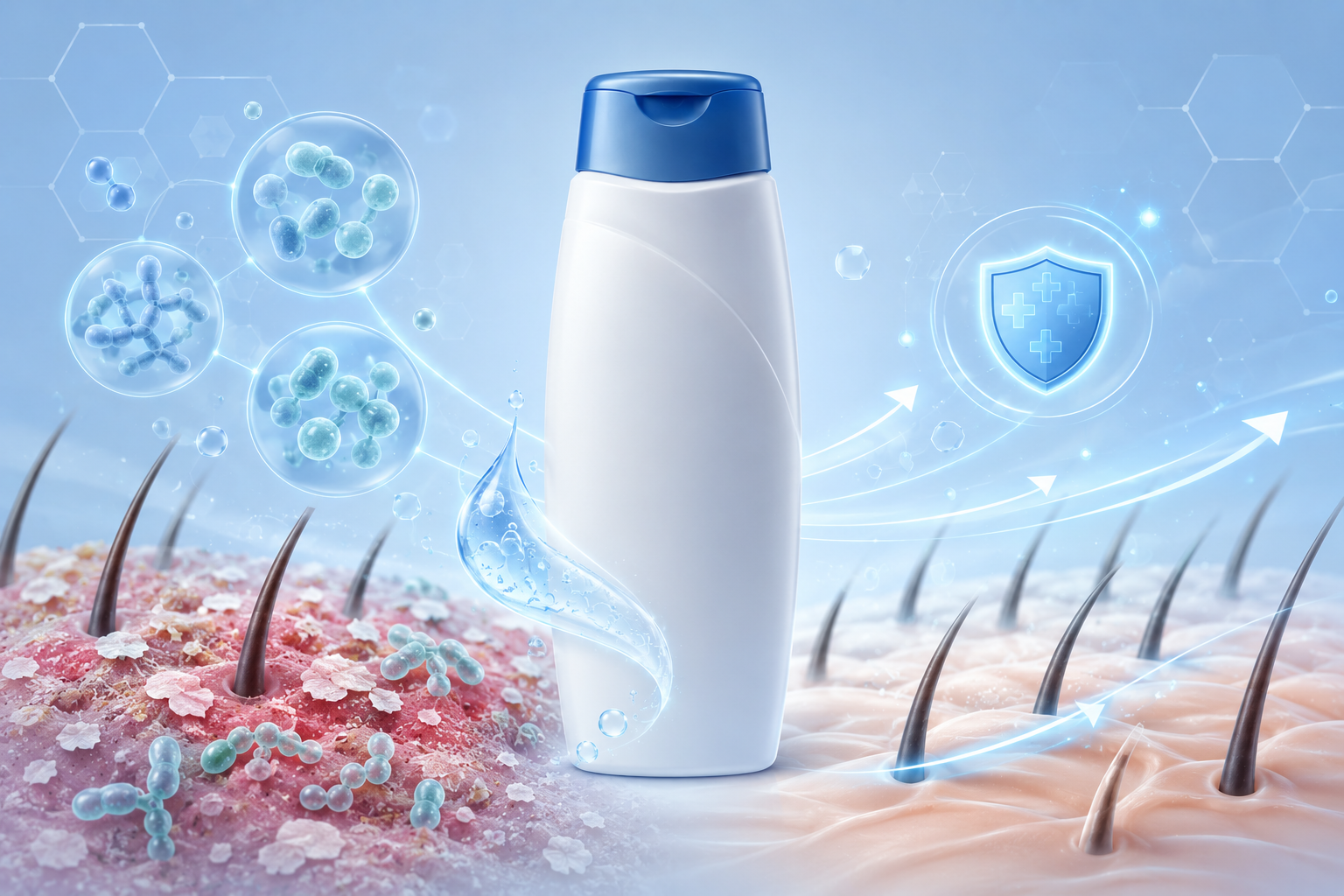
Ketoconazole shampoo targets the root cause of seborrheic dermatitis by suppressing Malassezia activity and reducing inflammation on the scalp. Its proven mechanism — inhibition of ergosterol synthesis — delivers strong, targeted antifungal action. Clinical studies show significant improvement in redness, scaling, and itching within 1–2 weeks, making it one of the most effective therapeutic shampoos for chronic seborrheic dermatitis.
Seborrheic dermatitis is strongly associated with an overgrowth of Malassezia yeasts, which trigger inflammation, redness, and persistent scaling on the scalp. Because this condition is driven by a fungal imbalance rather than simple dryness or irritation, antifungal therapy plays a central role in treatment. Ketoconazole shampoo is one of the most widely studied options due to its ability to directly suppress Malassezia activity and reduce the inflammatory response it causes.
Unlike regular anti‑dandruff shampoos that rely on milder agents such as zinc pyrithione or selenium sulfide, ketoconazole provides a more targeted mechanism by inhibiting ergosterol synthesis in fungal cell membranes. This makes it particularly effective for chronic or recurrent seborrheic dermatitis. Both 1% and 2% formulations work through the same pathway, but the 2% prescription strength delivers a stronger antifungal effect and is often recommended for more pronounced symptoms.
Seborrheic dermatitis is closely linked to the activity of Malassezia yeasts, which thrive in lipid‑rich areas of the scalp. When these yeasts proliferate, they produce metabolites that irritate the skin and trigger an inflammatory response. This inflammation contributes to redness, itching, and the characteristic greasy or flaky scaling seen in the condition.
The inflammatory process also disrupts the skin barrier, making the scalp more reactive and less capable of retaining moisture. As the barrier weakens, irritation intensifies, creating a cycle of inflammation and scaling. This impaired barrier function is a key factor in the chronic and recurrent nature of seborrheic dermatitis.
Suppressing Malassezia helps break this cycle. By reducing fungal activity, inflammation decreases, the skin barrier begins to recover, and symptoms gradually improve. This is why antifungal treatments such as ketoconazole are central to managing seborrheic dermatitis rather than simply masking surface flaking.
Ketoconazole shampoo acts through a well‑defined antifungal mechanism that directly targets the underlying drivers of seborrheic dermatitis. Its primary action is the inhibition of ergosterol synthesis, a structural component essential for fungal cell membranes. By disrupting this pathway, ketoconazole weakens Malassezia yeasts and limits their ability to proliferate on the scalp.
As Malassezia activity decreases, the inflammatory response it triggers begins to subside. This leads to noticeable reductions in redness, itching, and greasy scaling — hallmark symptoms of seborrheic dermatitis. The anti‑inflammatory effect is not direct but results from lowering the fungal load and reducing the irritants produced by the yeast.
With inflammation controlled, the scalp’s barrier function gradually improves. A healthier barrier helps retain moisture, reduces sensitivity, and prevents the cycle of irritation and flaking from recurring. This combination of antifungal action, inflammation reduction, and barrier restoration explains why ketoconazole shampoo remains one of the most effective therapeutic options for managing seborrheic dermatitis.
Ketoconazole shampoo is available in two concentrations that differ in strength, accessibility, and clinical performance. The 1% formulation is an over‑the‑counter option designed for mild to moderate seborrheic dermatitis. It provides a gentler antifungal effect and is often used for maintenance or for individuals who experience only intermittent flare‑ups. In contrast, the 2% prescription formulation delivers a more potent suppression of Malassezia activity, making it suitable for more persistent inflammation, heavier scaling, or chronic symptoms that do not respond to milder products.
Clinical studies consistently show that both concentrations improve redness, itching, and flaking, but the 2% version typically demonstrates faster and more pronounced results. This difference is attributed to its higher antifungal potency and longer residual activity on the scalp. The 1% formulation remains effective but tends to work more gradually, making it a practical choice for ongoing control once symptoms are stabilized.
In practice, the 1% shampoo is commonly used for routine management or mild disease, while the 2% formulation is selected for acute flare‑ups or cases where stronger antifungal action is needed. Both share the same mechanism of action, but their differing intensities allow treatment to be tailored to symptom severity.
Ketoconazole shampoo is typically used on the scalp and other affected areas with visible flaking, redness, or itching. First, thoroughly wet the hair and skin, then apply a small amount of shampoo and gently massage it into the scalp, hairline, and any seborrheic patches. Work it into a soft lather, ensuring even coverage without vigorous scrubbing that could irritate the skin.
After application, the shampoo is usually left on the skin for several minutes to allow the active ingredient to act on yeast and inflammation. A common approach is to leave it in place for about 3–5 minutes before rinsing thoroughly with lukewarm water. Avoid contact with the eyes and mucous membranes, and rinse immediately if this occurs.
Frequency of use often ranges from two to three times per week during flare-ups, then less often for maintenance, depending on severity and product strength. Overuse may lead to dryness or irritation, while underuse can reduce control of symptoms. Effectiveness is influenced by consistent use, adequate contact time, and gentle cleansing habits. Using harsh styling products, very hot water, or aggressive mechanical friction can worsen irritation and diminish the benefits of ketoconazole shampoo.
Clinical studies consistently show that ketoconazole shampoo provides strong antifungal and anti‑inflammatory activity in seborrheic dermatitis. Trials demonstrate significant reductions in scaling, erythema, and itching, with measurable improvement often beginning within the first one to two weeks of regular use. Its mechanism targets Malassezia species, which play a central role in symptom persistence, making it effective across mild to moderate presentations.
When compared with selenium sulfide, ketoconazole frequently shows similar or superior reductions in flaking and irritation, while offering better cosmetic tolerability and less odor. Against zinc pyrithione, ketoconazole typically demonstrates faster symptom control and greater reduction of yeast density, especially in cases with pronounced inflammation or recurrent flare patterns.
Clinical evidence also indicates that ketoconazole can support longer remission intervals when used consistently during the acute phase and then tapered to a maintenance schedule. Many studies report sustained symptom control for several weeks after discontinuation, reflecting its durable antifungal effect and its ability to reduce the underlying microbial load that drives relapse.
Ketoconazole shampoo is generally well‑tolerated, but some users may experience mild scalp dryness as the product reduces excess oil and targets yeast activity. This dryness can appear as tightness, increased flaking, or a slightly rough scalp surface, especially during the first weeks of use.
Irritation is another possible reaction and may include redness, itching, or a temporary burning sensation after application. These effects are usually mild and tend to lessen as the scalp adjusts. In some cases, the shampoo may cause subtle changes in hair texture, such as increased stiffness or reduced smoothness, due to its cleansing and antifungal properties.
Rare reactions have been reported, including localized rash or heightened sensitivity in individuals with very reactive skin. Although uncommon, these effects typically resolve after discontinuing use. Overall, ketoconazole shampoo maintains a strong safety profile when used as directed, with most side effects being mild, temporary, and manageable.
Although ketoconazole shampoo is effective for many cases of seborrheic dermatitis, it may offer limited benefit when the condition is not driven by Malassezia overgrowth. In such situations, symptoms may persist despite regular use because the underlying mechanism is unrelated to fungal activity.
Scalp psoriasis is another condition where ketoconazole typically provides little improvement. Psoriatic plaques are driven by immune‑mediated inflammation rather than yeast proliferation, so antifungal shampoos do not address the core process. Similarly, contact dermatitis—whether triggered by hair products, allergens, or irritants—does not respond to ketoconazole, as the issue stems from skin sensitivity rather than microbial imbalance.
In cases of pronounced inflammation, swelling, or intense redness, ketoconazole alone may not be sufficient. Severe flares often require other therapeutic approaches to reduce inflammation and restore the skin barrier. Recognizing these scenarios helps set realistic expectations and highlights when alternative or additional treatments may be necessary.
Ketoconazole shampoo is used to control Malassezia‑associated inflammation, reduce flaking, and stabilize the scalp barrier. Its effectiveness depends on concentration, frequency of use, and adherence during flare and maintenance phases. The table below summarizes key characteristics relevant to seborrheic dermatitis management.
| Parameter | Details |
|---|---|
| Concentration | 1% OTC or 2% prescription |
| Speed of Improvement | Visible reduction in scaling and redness within 1–2 weeks |
| Indications | Malassezia‑related seborrheic dermatitis and dandruff |
| Frequency of Use | 2–3 times weekly during flares; less often for maintenance |
| Key Features | Antifungal action, anti‑inflammatory effect, supports longer remission |