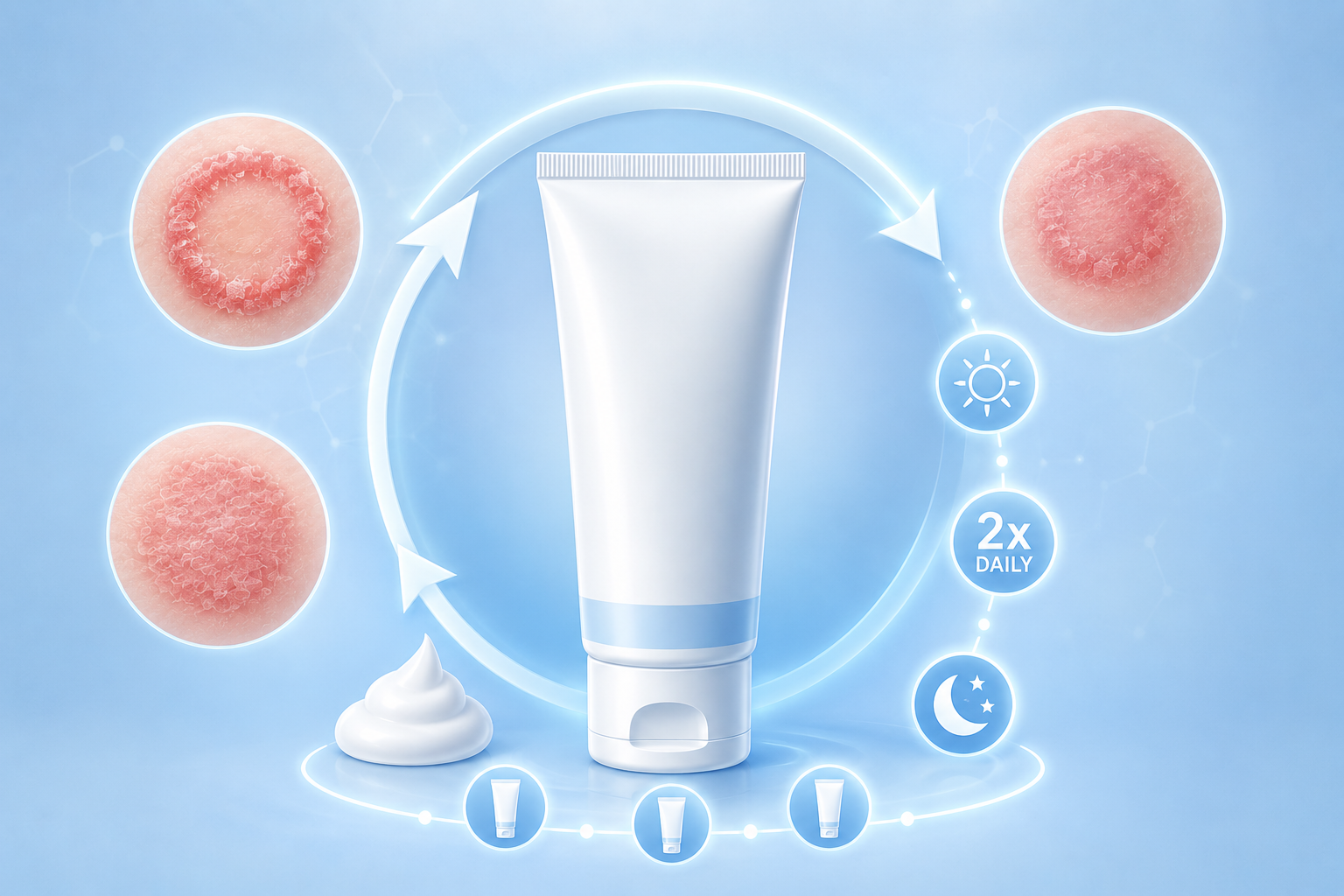
Ketoconazole cream is a broad‑spectrum topical antifungal used for common skin fungal infections, including dermatophytes, yeast‑related conditions, and pityriasis versicolor. It targets fungal overgrowth directly in the epidermis, helping reduce redness, itching, and scaling while restoring skin balance.
Ketoconazole cream is a topical antifungal treatment used to manage a wide range of superficial fungal skin infections. It is primarily applied to areas affected by dermatophytes and yeasts, making it suitable for conditions such as tinea corporis, tinea cruris, and cutaneous Candida. Because these infections are confined to the outer layers of the skin, the cream delivers targeted action exactly where it is needed.
Among all ketoconazole formulations, the cream is considered the main option for treating skin‑based fungal infections. Unlike ketoconazole shampoo, which is designed for the scalp and hair‑bearing areas, the cream penetrates the epidermis more effectively. Tablets, while systemic, are rarely used due to safety considerations and are not typically recommended for routine dermatologic infections.
With its broad activity against both dermatophytes and yeast species, ketoconazole cream remains a versatile and widely used choice for localized fungal skin conditions.
Ketoconazole cream is widely used for tinea corporis due to its strong activity against dermatophytes and its ability to penetrate the superficial layers of the epidermis where the infection resides. The cream concentrates in the stratum corneum, allowing it to disrupt fungal cell membrane synthesis directly at the site of infection. This localized action makes it particularly effective for ringworm lesions that form on smooth, non–hair-bearing skin.
Clinical studies show that ketoconazole cream provides consistent improvement in symptoms such as redness, scaling, and itching within the first one to two weeks of treatment. Its fungistatic and fungicidal effects help reduce fungal load quickly, contributing to visible clearing of lesions over the course of therapy. Because tinea corporis is a superficial infection, the cream’s epidermal penetration is sufficient to reach the affected tissue without the need for systemic medication.
Overall, ketoconazole cream offers a reliable and well‑studied option for managing tinea corporis, delivering both symptom relief and effective fungal control with regular application.
Ketoconazole cream is frequently used for tinea cruris because dermatophytes—the fungi responsible for jock itch—are highly sensitive to azole antifungals. The cream penetrates the superficial layers of the groin area, where the infection typically remains confined, allowing it to disrupt fungal cell membrane synthesis directly at the site of overgrowth. This localized action makes it effective for reducing itching, redness, and irritation associated with tinea cruris.
Ketoconazole is often preferred when both dermatophytes and yeasts may be contributing to symptoms, as its spectrum includes activity against Malassezia and Candida species. This broader coverage can be useful in cases where moisture, friction, and mixed microbial involvement complicate the presentation.
Compared with terbinafine, which is typically faster for dermatophyte-only infections, ketoconazole offers a more versatile profile when yeast involvement is possible. Its reliable penetration into the epidermis and well-documented clinical performance make it a strong option for managing tinea cruris, especially in recurrent or moisture-prone areas.
Ketoconazole cream can be effective for the interdigital form of tinea pedis, where the infection remains within the superficial layers of the skin between the toes. In these areas, the cream penetrates the stratum corneum sufficiently to disrupt fungal cell membrane synthesis and reduce symptoms such as itching, maceration, and peeling. Its activity against dermatophytes makes it a suitable option for mild to moderate interdigital involvement.
However, its effectiveness is more limited in the hyperkeratotic (moccasin-type) form of tinea pedis, where thickened skin and deeper scaling reduce penetration of topical azoles. In such cases, the infection extends beyond the superficial epidermis, making it harder for ketoconazole cream to reach the full depth of fungal involvement.
For hyperkeratotic or chronic forms, other treatments—such as agents with stronger keratin penetration or alternative antifungal classes—are often considered more suitable. Nonetheless, ketoconazole cream remains a practical choice for interdigital athlete’s foot, especially when yeast involvement or mixed infections are suspected.
Ketoconazole cream shows moderate activity against Candida species and can be used for mild, localized yeast infections of the skin. It acts within the superficial epidermis, where Candida typically colonizes moist, occluded areas such as skin folds. By inhibiting ergosterol synthesis in the fungal cell membrane, the cream helps reduce yeast density and improve symptoms like redness, maceration, and discomfort.
The cream may be particularly useful when Candida involvement coexists with dermatophytes or Malassezia, as its spectrum covers both yeasts and filamentous fungi. In intertriginous areas, regular application can support restoration of the skin barrier when combined with good hygiene and moisture control.
Compared with clotrimazole, which is often considered a first-line azole for uncomplicated cutaneous Candida, ketoconazole offers a somewhat broader profile toward Malassezia and certain dermatophytes. Clotrimazole is widely used for straightforward Candida intertrigo, while ketoconazole cream may be chosen when mixed infections or Malassezia-associated conditions are suspected alongside Candida-related inflammation.
Ketoconazole cream is widely used for pityriasis versicolor due to its strong activity against Malassezia, the yeast responsible for this condition. The cream works by inhibiting ergosterol synthesis in the fungal cell membrane, reducing the density of Malassezia on the skin and helping restore normal pigmentation over time. Because the infection is confined to the superficial epidermis, topical ketoconazole provides targeted action exactly where the yeast proliferates.
Both cream and shampoo formulations are used for pityriasis versicolor, but they serve different purposes. The cream is suitable for localized patches on the trunk, neck, or arms, while the shampoo is often preferred for widespread involvement because it can cover larger areas more efficiently. Clinical studies show that ketoconazole leads to noticeable improvement in scaling and discoloration within one to two weeks, although full repigmentation may take longer.
Recurrence is common with pityriasis versicolor, and maintenance strategies are often recommended. Periodic use of ketoconazole shampoo on high‑risk areas is a common preventive approach, as it helps control Malassezia overgrowth and reduces the likelihood of future flare‑ups.
Ketoconazole cream is designed for superficial fungal infections of the skin, which means it is not effective for conditions that extend deeper than the outer epidermal layers. One of the most notable limitations is nail fungus, where the infection penetrates the nail plate and nail bed — areas that topical creams cannot adequately reach.
The cream is also ineffective for deep fungal infections, including those involving the dermis, subcutaneous tissue, or internal organs. These conditions require systemic evaluation and treatment approaches that go beyond topical therapy. Similarly, infections of the scalp and hair follicles are not well managed with ketoconazole cream, as it cannot penetrate deeply into hair-bearing structures.
Systemic fungal infections fall entirely outside the scope of topical ketoconazole. Because these infections involve internal tissues or the bloodstream, topical formulations provide no benefit. In such cases, appropriate medical assessment is essential to determine suitable systemic treatment options.
Ketoconazole cream is primarily used for superficial fungal and yeast-related skin conditions. Its effectiveness depends on the infection type, depth of involvement, and whether alternative treatments offer better penetration or broader activity. The table below summarizes key use cases and suitable alternatives.
| Disease | Effectiveness | Depth of Action | Application Form | Alternatives |
|---|---|---|---|---|
| Tinea corporis | High | Superficial epidermis | Cream | Terbinafine, clotrimazole |
| Tinea cruris | High | Superficial epidermis | Cream | Terbinafine |
| Tinea pedis (interdigital) | Moderate | Superficial epidermis | Cream | Terbinafine, butenafine |
| Cutaneous Candida | Moderate | Superficial epidermis | Cream | Clotrimazole, miconazole |
| Pityriasis versicolor | High | Superficial epidermis | Cream / Shampoo | Ketoconazole shampoo, selenium sulfide |