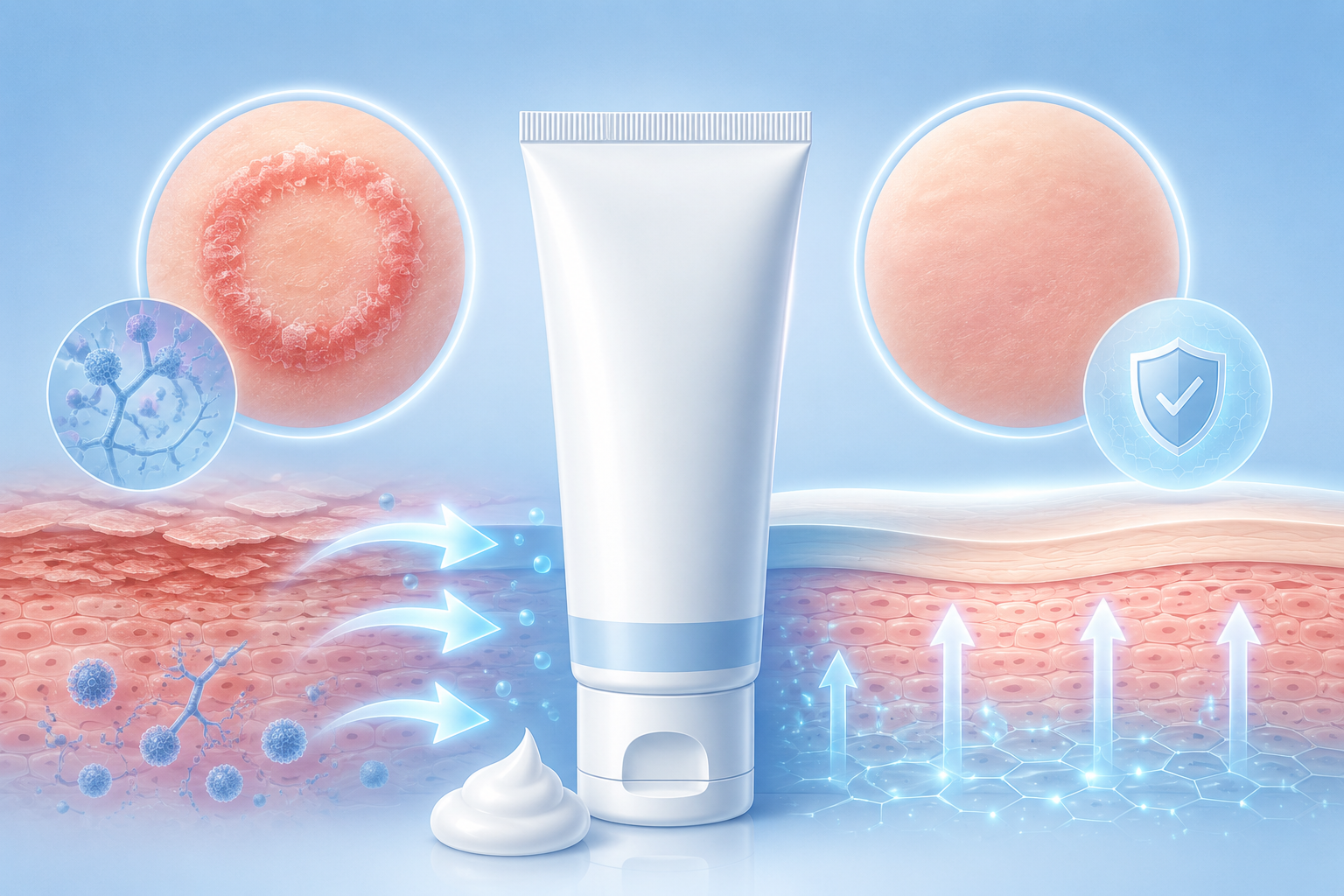
Ketoconazole cream provides broad-spectrum antifungal activity, targeting dermatophytes, yeasts, and Malassezia-related skin conditions. Its localized action in the epidermis helps reduce itching, redness, and scaling while addressing the underlying fungal overgrowth across different infection types.
Ketoconazole cream is a topical antifungal formulation designed specifically for treating superficial fungal infections of the skin. It is widely used because it provides direct, localized action against organisms that remain within the outer layers of the epidermis, where most common fungal infections develop and persist.
The cream is effective against both dermatophytes and yeast species, including Candida and Malassezia. Its ability to penetrate the superficial stratum corneum allows it to disrupt fungal cell membrane synthesis exactly where fungal overgrowth occurs, making it suitable for conditions such as ringworm, jock itch, athlete’s foot, and yeast‑related irritation.
Unlike ketoconazole shampoo, which is intended for scalp and widespread Malassezia‑related conditions, the cream is optimized for targeted skin application. Tablets, on the other hand, are rarely used due to systemic risks and are reserved for severe or resistant infections. This makes ketoconazole cream the preferred option for most localized, superficial fungal infections.
Ketoconazole cream works by targeting a key component of the fungal cell membrane: ergosterol. It inhibits enzymes involved in ergosterol synthesis, disrupting the normal structure and function of the membrane. Without sufficient ergosterol, the membrane becomes unstable, more permeable, and unable to maintain essential cellular processes.
As the fungal cell membrane is progressively damaged, vital intracellular contents leak out, leading to growth inhibition and eventual cell death. This direct effect on the membrane explains why ketoconazole is active against a broad range of dermatophytes and yeasts that rely on ergosterol for membrane integrity.
The cream acts locally within the epidermis, concentrating in the superficial stratum corneum where most fungal skin infections reside. Because its penetration is largely limited to these outer layers, ketoconazole cream is particularly effective for superficial infections rather than deep or systemic disease. This localized action allows high antifungal activity at the site of infection while minimizing systemic exposure, making it well suited for common skin fungus conditions.
Tinea corporis, commonly known as ringworm of the body, is one of the fungal infections most responsive to ketoconazole cream. Dermatophytes that cause this condition show high sensitivity to azole antifungals, making ketoconazole an effective option for reducing scaling, redness, and the characteristic ring‑shaped lesions. Its ability to concentrate in the superficial epidermis allows it to act directly where dermatophytes proliferate.
Clinical data demonstrate that ketoconazole cream can lead to noticeable improvement within one to two weeks, with reductions in itching and lesion size often appearing early in treatment. Studies also show strong mycological clearance rates when the cream is applied consistently, especially in mild to moderate cases.
Ketoconazole is often preferred when ringworm coexists with yeast involvement or when a broader antifungal spectrum is desirable. It is also useful when patients require a well‑tolerated topical option for sensitive skin areas. While other antifungals may act faster in some cases, ketoconazole remains a reliable choice for superficial tinea corporis due to its broad activity and favorable clinical outcomes.
Tinea cruris affects the groin folds, an area where warmth, friction, and moisture create ideal conditions for dermatophyte growth. Ketoconazole cream is effective for this infection because it reduces fungal activity directly within the superficial epidermis, helping relieve itching, redness, and irritation that commonly develop in skin folds. Its broad antifungal spectrum makes it suitable for cases where both dermatophytes and yeast may contribute to symptoms.
Clinical observations show that ketoconazole cream can lead to noticeable improvement within the first one to two weeks of treatment, with reductions in discomfort often appearing early. Because the groin area is prone to maceration and secondary irritation, a well‑tolerated topical antifungal like ketoconazole is often preferred for maintaining comfort while addressing the underlying fungal overgrowth.
Compared with terbinafine, ketoconazole may act slightly slower in some cases, but it offers broader coverage against yeast‑related components that can accompany tinea cruris. This makes it a practical choice when the clinical picture suggests mixed involvement or when a versatile topical antifungal is needed for sensitive fold areas.
Tinea pedis is one of the most common fungal infections of the feet, and ketoconazole cream is generally effective for the interdigital form, where the infection remains confined to the superficial layers of the skin between the toes. In these cases, the cream helps reduce itching, peeling, and maceration by lowering fungal activity directly in the epidermis. Its localized penetration makes it suitable for mild to moderate presentations where dermatophytes remain near the surface.
However, ketoconazole cream has limited effectiveness in the hyperkeratotic (moccasin-type) form of tinea pedis. This variant involves thickened, dry, scaling skin on the soles and sides of the feet, where the stratum corneum becomes too dense for topical azoles to penetrate adequately. Because the infection extends deeper into the keratinized layers, treatment often requires agents with stronger keratin penetration or systemic therapy.
In cases of extensive hyperkeratosis, recurrent infections, or poor response to topical azoles, other medications—such as terbinafine or oral antifungals—are typically preferred. Ketoconazole cream remains a practical option for interdigital tinea pedis but is not the best choice for thick, chronic, or widespread plantar involvement.
Cutaneous candidiasis refers to superficial yeast infections of the skin, often occurring in warm, moist areas such as skin folds, under the breasts, or in the groin. Ketoconazole cream shows moderate activity against Candida species and can be useful for mild to moderate, localized infections. By inhibiting ergosterol synthesis in the fungal cell membrane, it helps reduce redness, maceration, and discomfort associated with Candida overgrowth on the skin surface.
The cream is particularly helpful when candidal involvement coexists with dermatophyte or Malassezia‑related conditions, offering a broader antifungal spectrum in a single topical product. It may be chosen when a patient already uses ketoconazole for other fungal skin problems and needs a unified treatment approach for overlapping infections.
Compared with clotrimazole, which is often considered a first‑line agent for pure Candida infections, ketoconazole may be slightly less favored as a primary choice in some guidelines. However, its broader coverage can be advantageous when the clinical picture is mixed or when previous clotrimazole therapy has provided only partial relief.
Pityriasis versicolor is caused by Malassezia, a yeast that disrupts normal skin pigmentation. Ketoconazole cream works by inhibiting ergosterol synthesis in the fungal cell membrane, which weakens Malassezia cells and reduces their ability to proliferate on the skin surface. Because the infection is confined to the superficial epidermis, the cream’s localized penetration is well suited for targeting the yeast directly where it accumulates.
Clinical data show that ketoconazole cream can improve scaling and discoloration within one to three weeks, although full pigment restoration may take longer. The cream is effective for small, localized patches, while ketoconazole shampoo is often preferred for widespread or recurrent cases due to easier application over large areas. Both forms share the same mechanism of action but differ in coverage and convenience.
For prevention of recurrences—which are common with Malassezia—intermittent use of ketoconazole shampoo is often recommended, while the cream may be used for targeted maintenance in areas prone to flare‑ups. This combined approach helps reduce the likelihood of repeated overgrowth and supports long‑term control of the condition.
Ketoconazole cream is designed for superficial fungal infections of the skin, but it has clear limitations. It is not effective for nail fungus, as the medication cannot penetrate the dense, keratinized structure of the nail plate. In these cases, topical creams generally fail to reach the infection site, and other treatment approaches are typically required.
The cream is also ineffective for deep fungal infections that extend beyond the superficial epidermis. Conditions involving the dermis or subcutaneous tissue require systemic therapy, as topical ketoconazole cannot reach deeper layers in therapeutic concentrations.
Infections of the scalp, particularly those caused by dermatophytes, are another area where ketoconazole cream does not perform well. Hair follicles limit penetration, making shampoos or systemic treatments more appropriate. Additionally, ketoconazole cream is not suitable for systemic fungal infections, which require oral or intravenous antifungal medications rather than topical therapy.
Ketoconazole cream provides targeted activity for superficial fungal infections, with stronger results in conditions caused by dermatophytes and Malassezia. Its effectiveness depends on the depth of infection, the organism involved, and whether thicker keratin layers limit penetration. The table below summarizes key patterns of response and suitable alternatives.
| Disease | Effectiveness | Depth of Action | Speed of Improvement | Alternatives |
|---|---|---|---|---|
| Tinea Corporis | High | Superficial epidermis | 1–2 weeks | Terbinafine, clotrimazole |
| Tinea Cruris | High | Superficial folds | 1–2 weeks | Terbinafine |
| Tinea Pedis | Moderate | Superficial (limited in thick skin) | 2–4 weeks | Terbinafine, oral antifungals |
| Cutaneous Candidiasis | Moderate | Superficial epidermis | 1–2 weeks | Clotrimazole, miconazole |
| Pityriasis Versicolor | High | Superficial epidermis | 1–3 weeks | Ketoconazole shampoo, selenium sulfide |